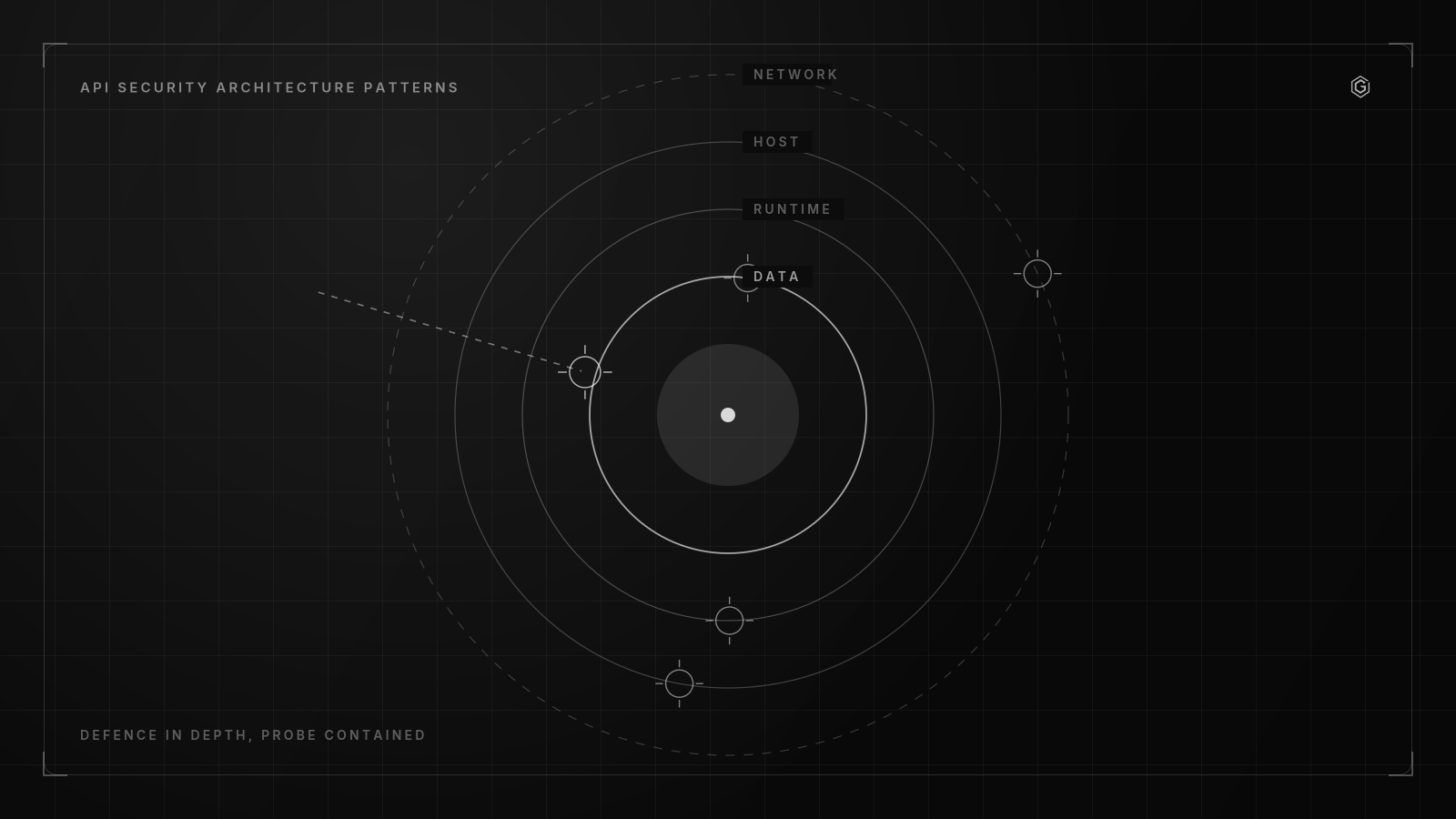
- The OSA SP-030 pattern mandates exactly 4 architectural layers: API Gateway, Authorization, Validation, and Monitoring, with zero direct backend access for all consumers.
- NIST SP 800-228 advocates for an incremental, risk-based approach to API security rather than attempting a single big-bang implementation across the estate.
- Default configurations in common gateways like Kong 3.x and AWS API Gateway often leave schema validation disabled or enforce weak TLS timeouts, requiring explicit hardening.
- Traditional WAFs cannot inspect structured API data or business logic abuse; they are a liability if used as the primary control for microservice east-west traffic.
- Enforcing mTLS in mixed service mesh environments (Istio, Linkerd, Consul) requires careful certificate rotation and policy precedence to avoid trust domain collision.
Step 1: Map Trust Boundaries and Inventory API Estates
You cannot secure what you haven't inventoried. The first step in any backend API security architecture is mapping the trust boundaries of your API estate. NIST SP 800-228, updated in March 2026, structures its guidance across three aspects: risk identification, recommended controls, and implementation analysis for pre-runtime and runtime stages.
Skip the inventory. Skip the risk identification phase entirely. Shadow APIs are undocumented endpoints that expose backend logic without authorization checks.
Zombie APIs are deprecated but still accessible. Both represent dangerous attack surfaces because they bypass the monitoring and validation controls applied to your primary traffic paths. According to the OSA SP-030 pattern draft from February 2026, every API consumer is untrusted and every request must carry credentials.
The NIST 800-53 CM-08 control requires a real-time inventory of all APIs. This isn't a wiki page; it's a machine-readable registry containing: - Every endpoint and version - Owner and consumer identities - Authentication method - Data classification - Deployment status
Maintaining this inventory carries a real administrative cost. Passive network scanning finds endpoints by observing traffic, which is cheap but misses anything unexercised. Active endpoint fuzzing probes the application surface, which finds zombie APIs but consumes backend resources and can trigger rate limits or integrity checks.
But I prefer active fuzzing in staging and passive scanning in production. The trade-off is coverage versus stability. What happens when you miss a zombie API?
CM-07 enforces least functionality. You must disable unused HTTP methods, remove debug endpoints, disable GraphQL introspection, and decommission deprecated API versions. Deny-by-default is the principle. If an endpoint isn't in the inventory, the gateway should reject it.
Every time I've seen this fail, the cause was the same: a deprecated v1 endpoint remained accessible behind the gateway while the service mesh routed traffic only to v2. And the fix was linking the gateway route configuration to the deployment pipeline so that decommissioning a version removed its route automatically. Your backend API security architecture depends on this automation.
How Does the OSA SP-030 Four-Layer Architecture Translate to Gateway Defaults?
The OSA SP-030 four-layer architecture maps to API gateway defaults by exposing their insufficiency. Kong 3.x, Envoy, and AWS API Gateway ship with permissive TLS, absent rate limits, and open schema validation. Hardening them requires explicit configuration flags for fail-closed behavior, strict TLS versions, and mandatory authentication at the edge.
According to the OSA SP-030 pattern draft, a secure architecture uses four layers: API Gateway, Authorization, Validation and Protection, and Monitoring and Incident Response. The three-layer defence principle is simple: authenticate at the gateway, authorise at the service, validate at every boundary, and the pattern references 45 NIST 800-53 Rev 5 controls across 13 control families. It mandates that all API consumers are untrusted and have no direct backend access.
Out-of-the-box defaults fail this standard.
| Control | Kong Gateway 3.x Default | Envoy Default | AWS API Gateway Default |
|---|---|---|---|
| TLS Version | 1.2 | 1.2 | 1.2 |
| Rate Limit Algorithm | None | None | Token bucket |
| Auth Timeout | 60s | 60s | 29s |
| Schema Validation | Disabled | Disabled | Enabled (REST only) |
These defaults prioritize connectivity over security. But you must change them to meet the SP-030 API Gateway layer requirements. For Kong 3.x, set NGINX_HTTP_SSL_PROTOCOLS to TLSv1.3 and configure the rate-limiting plugin with redis as the strategy and limit_by set to consumer.
For AWS API Gateway, enable throttling at the stage level and use a custom authorizer with a short timeout.
And for Envoy, you configure the JWT authentication filter to ensure requests without valid tokens are rejected at the edge.
# Envoy JWT authentication filter for fail-closed behavior
http_filters:
- name: envoy. filters. http. jwt_authn
 typed_config:
 "@type": type.googleapis.com/envoy. extensions. filters. http. jwt_authn. v3. JwtAuthentication
 providers:
 primary:
 issuer: "https://auth.example.com"
 audiences:
 - "api.example.com"
 from_headers:
 - name: Authorization
 value_prefix: "Bearer "
 remote_jwks:
 http_uri:
 uri: "https://auth.example.com/.well-known/jwks.json"
 cluster: auth_backend
 timeout: 1s
 cache_duration: 300s
 rules:
 - match:
 prefix: "/"
 requires:
 provider_name: primary
This configuration blocks any traffic lacking a valid JWT, and it enforces the deny-by-default principle at the gateway. If the JWKS endpoint fails, the filter fails closed. Your backend API security architecture depends on this behavior.
Step 2: Implement Schema-First Validation and Fail-Closed Authorization
Schema-first development is not a documentation exercise. It is a runtime constraint. The OSA SP-030 pattern maps the API lifecycle into four phases: Design, Develop, Deploy, and Operate, with deprecation as a terminal activity.
The Design phase requires threat modelling and schema-first development. The Develop phase requires input validation and security tests.
API7 defines layered API security as placing controls at points where they have the right context. Identity systems establish caller identity. The gateway applies shared runtime controls.
Services enforce domain-specific authorization. This division of labor is the core of a functional Backend API Security Architecture.
The OSA SP-030 pattern covers five API communication styles: REST, GraphQL, gRPC, WebSocket, and event-driven. Your schema must handle all of them. The NIST 800-53 SI-10 control requires input validation. Your OpenAPI 3.1 schema is the contract.
{
  "openapi": "3.1.0",
  "info": {
    "title": "Orders API",
    "version": "1.0.0"
  },
  "paths": {
    "/orders": {
      "post": {
        "requestBody": {
          "required": true,
          "content": {
            "application/json": {
              "schema": {
                "type": "object",
                "required": ["orderId", "amount"],
                "properties": {
                  "orderId": {"type": "string", "format": "uuid"},
                  "amount": {"type": "integer", "minimum": 1, "maximum": 100000}
                },
                "additionalProperties": false
              }
            }
          }
        }
      }
    }
  }
}
The additionalProperties: false setting is critical. It prevents parameter injection. You enforce this schema using an Envoy ext_proc filter.
# Envoy ext_proc configuration for OpenAPI 3.1 validation
http_filters:
- name: envoy.filters.http.ext_proc
  typed_config:
    "@type": type.googleapis.com/envoy.extensions.filters.http.ext_proc.v3.ExternalProcessor
    grpc_service:
      envoy_grpc:
        cluster_name: ext_proc_server
      timeout: 0.250s
    failure_mode_allow: false
    processing_mode:
      request_body_mode: BUFFERED
failure_mode_allow: false ensures the filter fails closed. If the ext_proc server is unavailable, Envoy rejects the request. The performance cost of validating payloads inline is real but bounded. You trade a few milliseconds of latency at the gateway for significant CPU cycles saved at the application level.
JWT validation libraries have a history of CVEs. CVE-2022-23529 affected node-jose and allowed algorithm confusion attacks. An attacker could forge a token signed with a symmetric algorithm using the public key as the secret.
The architectural control that mitigates this is restricting the allowed algorithms at the gateway. Never accept none as an algorithm. Pin RS256 or ES256.
Schema drift breaks production traffic. If the service expects a new field but the gateway schema does not allow it, the gateway rejects valid traffic. The fix is a CI pipeline check that compares the deployed gateway schema against the service schema on every merge.
This prevents drift from breaking production traffic.
Contrarian View: Why a WAF Is a Liability in Microservice Architectures
Traditional Web Application Firewalls are insufficient because APIs expose structured data and business logic, not rendered web pages. A WAF inspects HTTP requests for patterns matching SQL injection or cross-site scripting. It doesn't understand the semantics of a JSON payload or the authorization rules governing a specific API endpoint.
The attacks that compromise APIs don't look like traditional web attacks. They target authentication, authorization, data exposure, rate limiting gaps, and business process abuse. A BOLA attack exploits object-level authorization.
A WAF cannot detect it because the request is syntactically valid. The user is authenticated. The user is simply requesting an object they shouldn't access.
So why rely on a WAF?
Relying on a WAF creates a false sense of security, and it secures the north-south perimeter while ignoring east-west traffic vulnerabilities. If an attacker breaches the edge, the internal services are wide open. But the OSA SP-030 pattern requires internal services to authenticate via mTLS or service mesh, with encryption at rest and baseline hardening.
It explicitly states no direct exposure of backend services.
Moving validation logic to the API gateway and service mesh provides a stronger, context-aware security posture. The gateway has the schema, and the service mesh has the workload identity. A WAF has neither.
The operational cost of this transition is significant. You must retrain your security team to read OpenAPI 3.1 specs instead of regex rules. You must rewrite your alerting to use gateway metrics instead of WAF logs.
This coupling is a feature, not a bug. It means that a schema change triggers a security review. It means that a new endpoint cannot go live without a corresponding gateway route and validation rule.
The WAF model decouples security from the application lifecycle. That decoupling is precisely why it fails for APIs. Your backend API security architecture requires defense in depth, but depth without context is just overhead.
Building something similar? Let's compare notes.
Response within 24 hours. No commitment required.
Step 3: Enforce East-West mTLS Across Mixed Service Mesh Environments
East-west traffic is the blind spot of most designs. Edge or API gateway controls may miss internal, direct-service, or alternate paths as a primary limitation, and the OSA SP-030 pattern requires internal services to authenticate via mTLS or service mesh. Service-mesh patterns provide workload identity and internal service context for microservices and east-west APIs.
Enforcing mTLS across a single mesh is trivial. Enforcing it across mixed mesh environments is not. If you run Istio and Linkerd in the same cluster, you must prevent trust domain collisions.
Both meshes use SPIFFE for workload identity. Istio defaults to a trust domain derived from the cluster name. Linkerd defaults to cluster.local.
And if they share a trust domain, a workload in one mesh can impersonate a workload in the other.
The fix is explicit trust domain configuration.
# Istio PeerAuthentication policy for strict mTLS
apiVersion: security.istio.io/v1beta1
kind: PeerAuthentication
metadata:
 name: default
 namespace: production
spec:
 mtls:
mode: STRICT# Linkerd Server configuration for strict mTLS
apiVersion: policy.linkerd.io/v1beta1
kind: Server
metadata:
name: orders-api
namespace: production
spec:
podSelector:
matchLabels:
app: orders-api
port: 8080
proxyProtocol: "TLS"These configurations enforce strict mTLS, and the STRICT mode in Istio rejects any plaintext traffic. The TLS proxyProtocol in Linkerd does the same. The latency overhead of mTLS comes from the handshake.
In a busy cluster, the CPU cost of continuous mTLS handshakes is non-trivial. You mitigate this by enabling session resumption and using a low-latency cryptographic suite.
The operational complexity of cross-mesh verification grows with the number of meshes. You need a unified identity plane. I use SPIRE as the workload identity provider for both meshes, and it issues SVIDs that are verifiable across trust domains.
The administrative overhead is real: - Configuring SPIRE servers in each cluster - Establishing federated trust relationships between clusters - Rotating SVIDs on a short schedule - Monitoring for certificate expiration
Your architecture is only as strong as the weakest trust domain. If you cannot verify the identity of the caller, you cannot enforce authorization. mTLS provides that verification at the runtime level.
What Are the Measurable Security and Performance Trade-offs of Inline vs. Out-of-Band Controls?
Inline controls block malicious traffic at the gateway, while out-of-band controls mirror traffic to a monitoring plane for analysis. The measurable trade-off is latency versus visibility. Inline adds processing time to every request, but out-of-band cannot block active attacks in real time.
The Ammune guide identifies 7 distinct API security architecture patterns with specific trade-offs in security posture and performance. The two extremes are inline reverse-proxy security and out-of-band mirrored monitoring. Inline security inspects every request before it reaches the service.
Out-of-band monitoring copies traffic to a separate plane for analysis.
You can measure the difference. I use k6 load testing to benchmark each pattern against a baseline of no security controls. The methodology is simple: 1.
Define a baseline load profile (e.g. 1000 virtual users, 1 minute duration) 2. Run the baseline against a raw endpoint 3.
Add an inline control (e.g. Envoy JWT filter) and rerun 4. Add an out-of-band control (e.g.
mirrored traffic to a debug service) and rerun 5. Compare p95 latency and throughput
The inline control adds latency at the gateway. The out-of-band control adds latency at the mirror point, but that latency doesn't affect the request path. The security trade-off is the critical difference.
Out-of-band monitoring provides visibility without introducing latency, but it cannot block active attacks in real time compared to inline controls. Are you willing to take that risk?
For large estates with several API paths and risk tiers, a hybrid architecture is recommended. It combines edge, runtime, application, and evidence controls. The challenge is deduplication.
If the edge validates the schema, the runtime shouldn't do it again. If the runtime enforces authorization, the application shouldn't repeat the check. This requires: - Clear ownership of each control - Policy precedence rules - Common identifiers across planes - A single source of truth for API schemas
A hybrid architecture deduplicates controls across the edge, runtime, and application planes. The edge handles authentication and rate limiting, and the runtime handles schema validation and payload inspection. The application handles business logic and domain-specific authorization.
The evidence plane handles logging and auditing.
The danger of a hybrid approach is overlapping controls. If the edge and the runtime both validate the same schema, you pay the latency cost twice. If the runtime and the application both check the same authorization rule, you create a maintenance burden.
But the fix is a strict policy of single responsibility. Each control belongs to exactly one plane.
On a recent build I took an inline Envoy filter with out-of-band mirroring for deep payload inspection over the obvious option of a single inline control, and the outcome was that the fast checks ran inline while the slow behavior profiling checks ran out of band without adding latency to the hot path.
Ready to build something that lasts?
Response within 24 hours. No commitment required.
Frequently Asked Questions