
ShippedTechnical Partner2026
SocrateOS
A cognitive operating system for a verified nonprofit built with MIT.
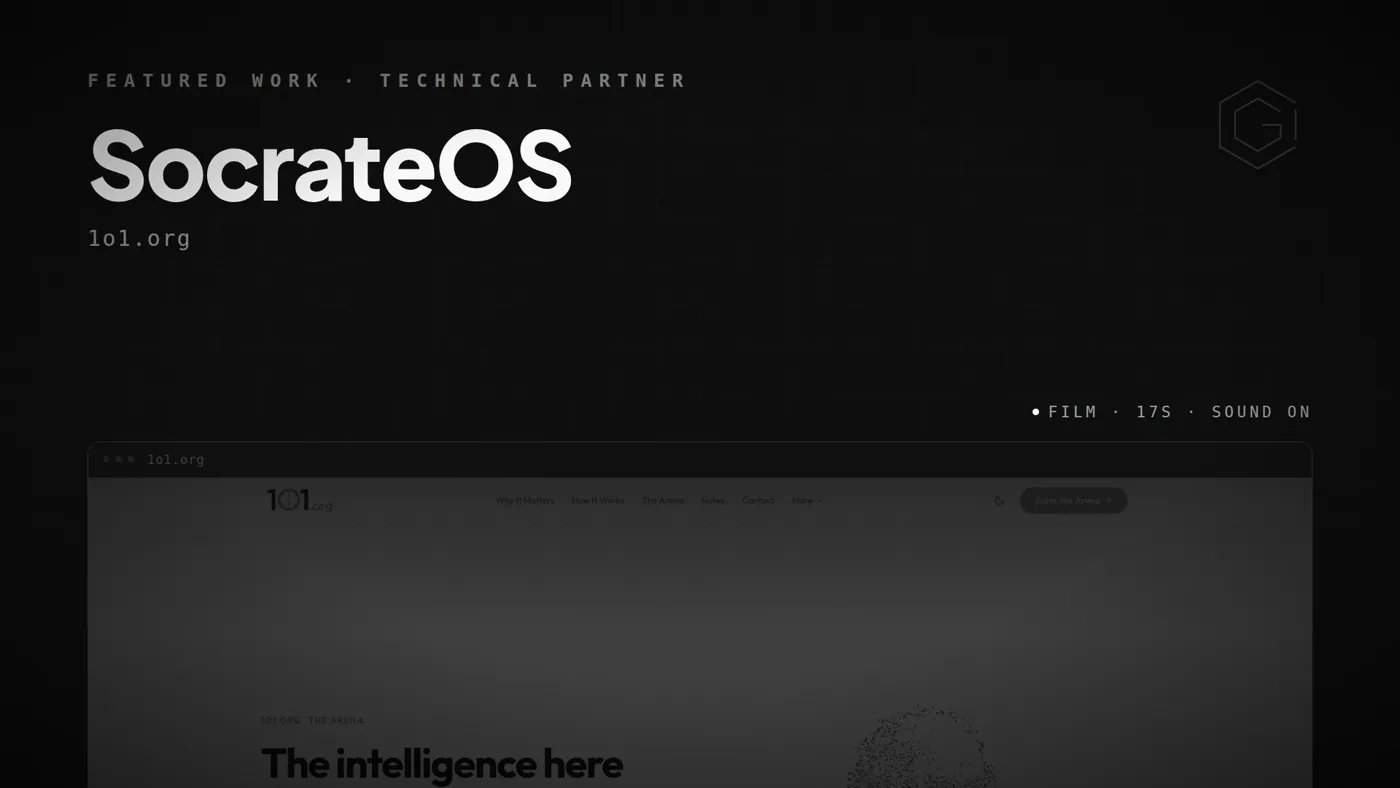
SocrateOS is a cognitive operating system built for 1o1.org: a dialectic chat engine with a persistent actor identity, a cognitive memory graph and a multi-persona board, delivered as a technical partner alongside MIT students on the client side.
What it is
Cognitive operating system for 1o1.org, a verified nonprofit founded by Romanus Berg in collaboration with MIT. Built as Technical Partner on the team, not just for hire: dialectic chat with persistent Actor identity, cognitive memory graph, multi-persona board, artifact minting, document intelligence and admin tooling.
Checkable facts
- Technical Partner alongside founder Romanus Berg
- Verified nonprofit, in collaboration with MIT
- Dialectic chat, cognitive memory graph, artifact minting
What a cognitive operating system is
A cognitive operating system is an application whose primary object is the user's thinking rather than their documents. It keeps who you are, what you have concluded, and how those conclusions connect, so that a conversation months apart is continuous instead of starting from an empty context window.
Most AI products are stateless underneath a chat transcript. They remember the last few thousand tokens and forget the reasoning. That works for tasks and fails for thinking, because thinking is exactly the activity where the value accumulates across sessions.
The brief was to build the version that does not forget: identity that persists, memory that is structured rather than appended, and a conversational method that argues rather than agrees.
Dialectic instead of assistance
The engine is dialectic: it takes positions and tests the user's reasoning rather than completing their request. That is a product decision with an architectural cost, because a system designed to disagree needs to hold a model of what the user believes, not just what they last typed.
An assistant optimises for agreement, which is why assistants are pleasant and rarely change anyone's mind. A dialectic engine has to remember a position across turns, notice when the user contradicts it, and be able to say so.
The multi-persona board came from this: several distinct positions in one conversation, each with its own stance, so a question meets argument from more than one direction at once.
The memory graph
Memory is a graph of connected conclusions, not a log of messages. Retrieval runs over PostgreSQL with pgvector, so recalling context means traversing what the user has established and how it links, rather than searching a transcript for a matching phrase.
A transcript search returns the moment something was said. A graph returns what it implies and what it contradicts, which is what a conversation about ideas actually needs.
The persistent actor identity sits on top of it: the system knows who it is talking to across sessions, which is the difference between a tool you reintroduce yourself to and one that continues where you left off.
What was delivered
Dialectic chat, persistent actor identity, the cognitive memory graph, the multi-persona board, artifact minting, document intelligence, staging infrastructure, subscriptions and admin tooling. Next.js on the front, FastAPI and PostgreSQL with pgvector behind it, OpenRouter for models, Stripe, PostHog, Resend, containerised and deployed through Dokploy.
The work ran as a sequence of approved milestones rather than one delivery, which is how a system of this size stays correctable: every milestone ended in something the client could run and check themselves.
A working MVP of the dialectic engine existed in ten days. The rest was the difference between a demonstration and a product: subscriptions, staging, admin, and the parts nobody sees until they are missing.
The measure that matters
The client wrote that the architecture was clean enough that a student cloned the repository and ran it independently. That is the most useful review a system can get, because it is not an opinion about quality, it is an observation that someone who did not build it could operate it.
The full review, seven paragraphs, is on this site and links to its source. It is on the testimonials section rather than paraphrased here, because a quotation that cannot be checked is worth less than no quotation.
The engagement remains open for further scope.
Questions
- What makes this different from a chatbot with long-term memory?
- The memory is a graph of conclusions and their relationships, not a store of past messages, and the conversational method is dialectic rather than assistive. A chatbot with memory recalls what you said. This recalls what you established, and argues with it.
- Why pgvector rather than a dedicated vector database?
- Because the graph and the embeddings belong to the same data and separating them into two systems buys you a synchronisation problem. PostgreSQL with pgvector keeps retrieval and relational structure in one place, which matters more than raw vector throughput at this scale.
- How was the work structured with the client?
- As approved milestones, each ending in something the client could run and verify themselves before the next began. The collaboration included MIT students on the client side, and the engagement is still open.
Facts on this page verified 2026-07-31