
In productionOwner & Founder2026
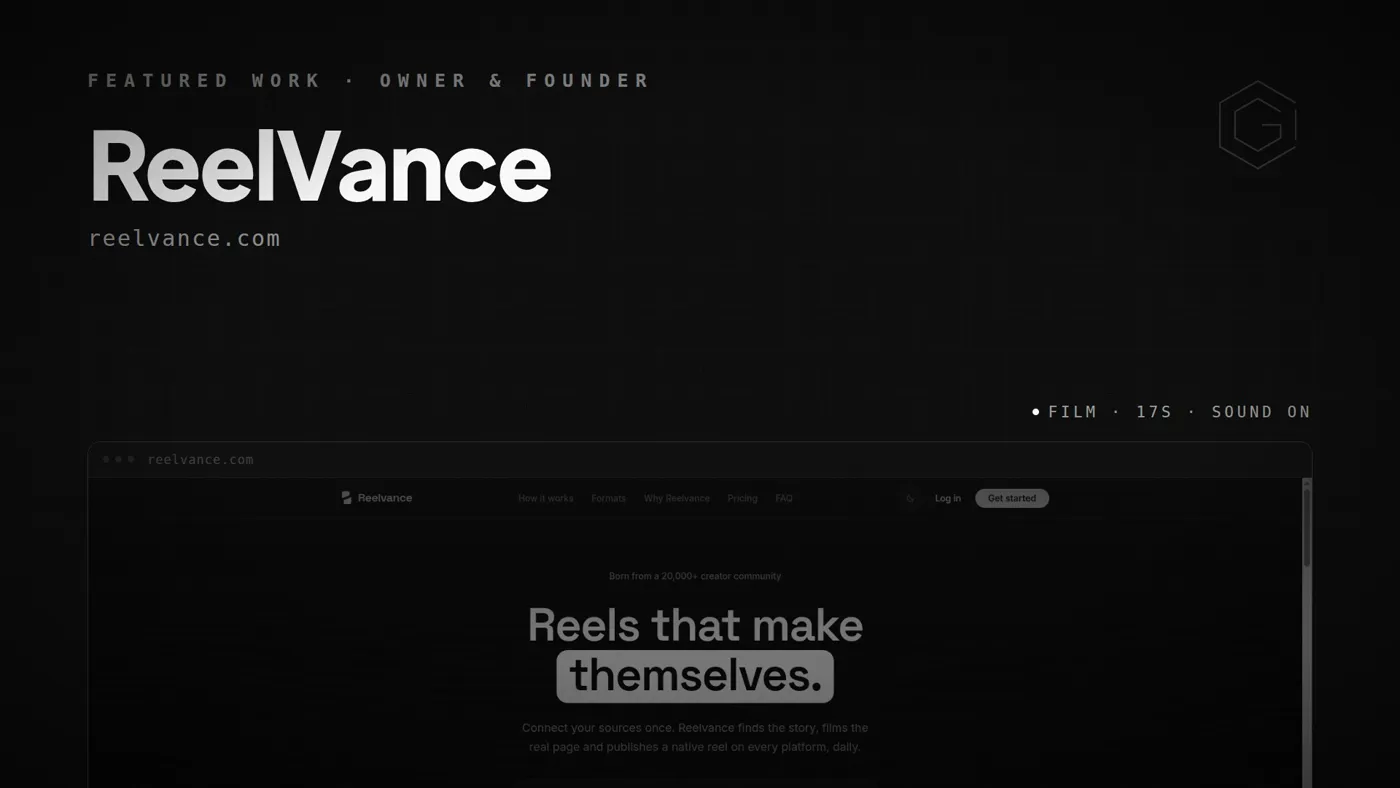
ReelVance
An autonomous short-video engine with a paid SaaS console.
ReelVance is an autonomous short-video engine: it discovers a subject, writes the script, produces the video and publishes it to three platforms without a human in the loop, with a paid console on top of it.
What it is
Autonomous short-video engine with a paid SaaS console. It discovers trends, writes scripts, renders video with voice and captions, then publishes to TikTok, Instagram and YouTube on its own. Built end-to-end solo: engine, website, billing, Discord bot.
Checkable facts
- Born from a 20,000+ creator community
- Runs entire channels autonomously, daily
- Full pipeline: discover → script → produce → publish
The problem it solves
Short-form video rewards volume and consistency, and both break on the same bottleneck: a person has to decide what to make, make it, and post it, every day. Every tool on the market removes one of those three steps and leaves the other two.
Editing tools make production faster. Schedulers make posting faster. Neither of them decides what to publish, and deciding is the step that actually consumes the person. A creator using both still sits down every day to a blank prompt.
The engine is built around the opposite premise: the chain from discovery to publication runs unattended, and the human intervenes to change the strategy rather than to execute it. That is a harder system to build, because every step has to be safe to run without supervision, and it is the only version worth building.
How the chain works, end to end
Four stages run in sequence on a cron daemon: discover a subject, write the script, render the video, publish it. Each stage writes its output to the next, and each one can fail without taking the chain down, because a stalled stage is recoverable and a corrupted publish is not.
Discovery and scripting go through OpenRouter, which keeps the model choice a configuration decision rather than an architectural one. Rendering is Remotion 4 with three.js and VRM for the animated presenter, Kokoro for text to speech, and Playwright where a real browser has to be captured rather than simulated.
Publishing is first-party OAuth to Google, TikTok and Meta, not a third-party posting service. That decision cost weeks and it is the reason the engine can run unattended: an intermediary that rate-limits you or loses its token is a dependency you cannot debug, and a publishing chain that cannot be debugged cannot be trusted to run while you sleep.
The whole engine is TypeScript in strict mode on Node 22 ESM, with an MCP server exposing it to agents and a credit ledger recording what each run consumed.
The decision that shaped everything: a ledger, not a counter
Usage is recorded as an append-only ledger of entries rather than a number that goes up and down. A counter tells you a customer has 40 credits left. A ledger tells you what happened to the other 20, which is the question that gets asked when something goes wrong.
An autonomous system spends the customer's money without asking each time. That is the whole value proposition and it is also the whole risk: the first time a run misfires and burns a month of credits, a balance number leaves you with nothing to reconstruct.
The ledger makes every deduction attributable to the run that caused it, which turns a support conversation from an argument into a lookup. It also made the refund guarantee possible to offer at all, because a guarantee you cannot audit is a guarantee you cannot honour.
Publishing safely without supervision
The engine ships a Monetization Safety Report on every piece it produces, scoring craft, originality, AI disclosure and policy risk. It exists because an unattended publisher is one bad output away from getting an account banned, and an account ban is not recoverable by a retry.
Automation that runs while you sleep needs a gate that is not you. The report is that gate: it evaluates the output against the platform policies that actually get accounts actioned, and it makes the judgement visible instead of implicit.
This is the same principle as the audit trail in the ledger. Anything that acts on your behalf has to be able to explain what it did afterwards, or you will not leave it running.
What it costs and what is guaranteed
Two plans, verified on the live pricing page on 25 July 2026: Pro at $24 a month for 60 credits, Ultra at $66 a month for 200. There is no free tier. If the autopilot does not publish the first 20 videos within 30 days, the first payment is refunded.
The absence of a free tier is deliberate and it is a real trade. A free step lowers the barrier and it also fills the system with runs that will never convert, on an engine where every run costs inference and rendering time. The refund guarantee carries the risk instead, and it puts the burden on the product performing rather than on the customer evaluating.
The guarantee is only offerable because of the ledger: "did it publish 20 videos in 30 days" is a query, not an opinion.
Running in production
The engine has been running five of my own social accounts unattended since July 2026. It is deployed through Dokploy behind Traefik, with the engine and the customer-facing site as separate services, and the console built on Next.js 16 with better-auth, Stripe, Resend and PostHog.
Using it on my own accounts before selling it is not a marketing line, it is the only way the failure modes surface. A pipeline that runs for a week looks finished. A pipeline that runs for two months meets token expiry, platform API changes, a model that starts refusing a prompt it used to accept, and a render that silently produces a black frame.
ReelVance came out of a creator community of more than 20,000 people, which is where the requirements came from: they are things creators complained about, not features imagined for a roadmap.
Questions
- What does "autonomous" actually mean here?
- That the chain from choosing a subject to publishing the finished video runs on a schedule with nobody approving each step. A person changes the strategy, the prompts and the accounts; the daily execution is not a person's job. That is different from a scheduler, which still needs you to make the thing it posts.
- Why build first-party OAuth publishing instead of using a posting service?
- Because an intermediary is a dependency you cannot debug. When a third-party service rate-limits you or loses a token, the failure surfaces on your account and the fix is not in your hands. For a system designed to run unattended, that is the one class of dependency worth the weeks it costs to remove.
- How is credit usage tracked?
- As an append-only ledger, where every deduction is attributable to the run that caused it, rather than a balance that increments and decrements. It makes support a lookup instead of an argument, and it is what makes the publishing guarantee auditable.
- What is the Monetization Safety Report?
- A score attached to every produced piece covering craft, originality, AI disclosure and policy risk. It is the gate that stands in for human review on an unattended publisher, because a single policy-violating post can cost an account permanently and no retry recovers that.
Facts on this page verified 2026-07-25