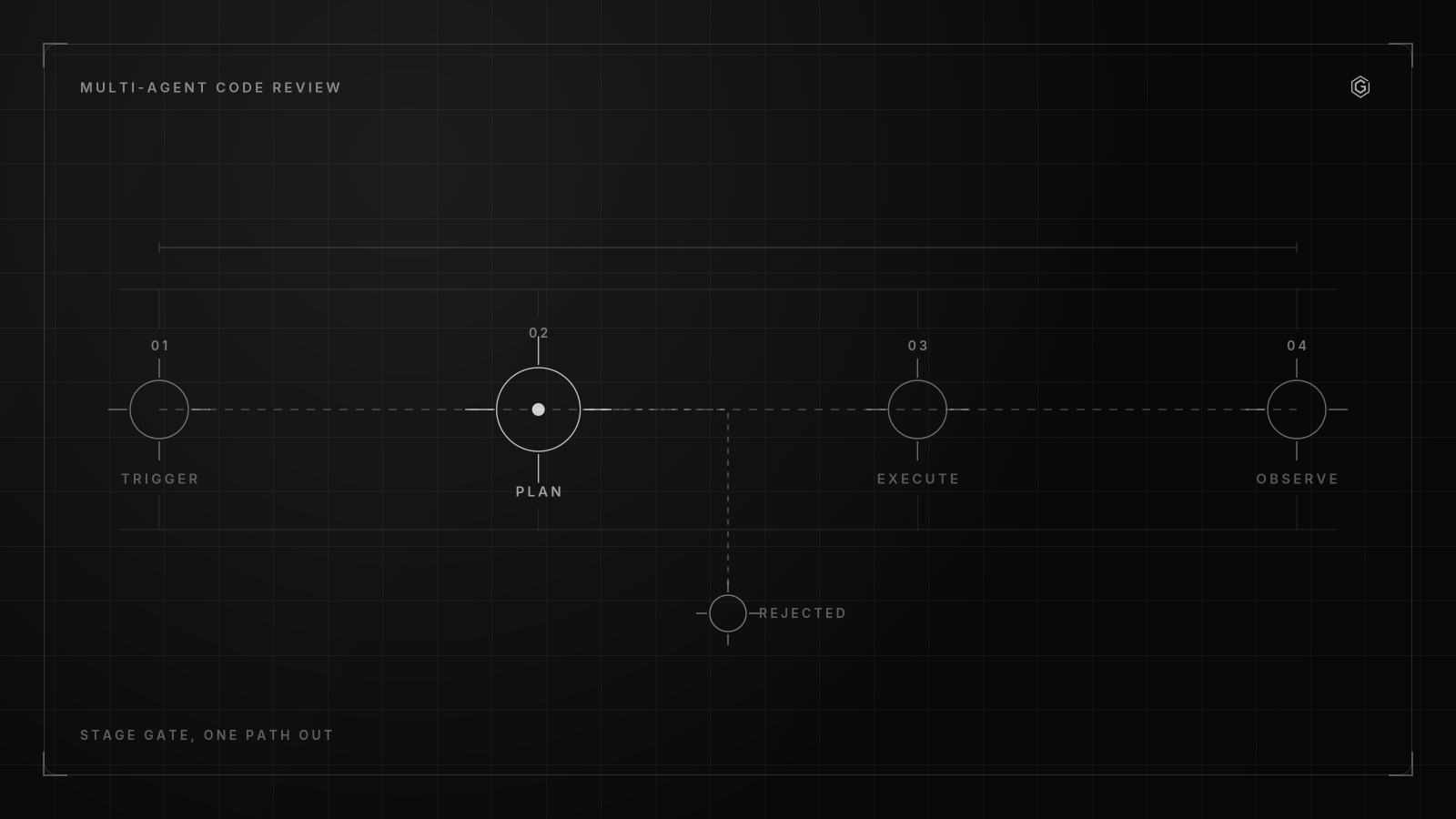
- Multi-agent orchestration using specialized AI reviewers (security, performance, compliance) dramatically outperforms single monolithic review prompts.
- Implementing risk tiering for merge requests allows architectural cost optimization by dynamically downgrading LLM models for trivial changes.
- Suppressing alert fatigue requires explicit prompt boundaries for what not to flag, paired with an explicit approval bias toward merging code.
What Is an Agentic AI Code Review Workflow?
An agentic AI code review workflow is a CI-native orchestration system that deploys specialized autonomous agents to analyze merge requests, deduplicate findings, and post structured feedback. It shifts the bottleneck from manual human verification to automated, intelligent routing. O'Reilly Radar's 2026 analysis proves verification is the new bottleneck, and the numbers are ugly.
The per-developer defect rate surged from 9% to 54%. Median review duration increased by 441.5%, with time to first review and average review time both roughly doubling. As AI output scales, writing code is cheap.
Checking it is expensive. What surprised me most about the sudden spike in AI-coauthored code was the sheer volume of false positives, because it runs counter to the usual advice that more checks equal better quality.
A copilot can generate hundreds of lines in seconds. So if your reviewer flags theoretical risks, developers will mute it. You need a system that deploys a specific agent skill for each domain.
The coordinator deduplicates findings and runs a reasonableness filter before posting anything to the merge request.
This prevents the client from seeing five overlapping warnings about the same issue. Setup checklist for deployment:
- [ ] Define VCS webhooks for merge requests
- [ ] Deploy specialized reviewer agents
- [ ] Configure AI gateway for token usage
- [ ] Enable telemetry and tracing tools
Stop using a single mega-prompt to review thousands of lines. It hallucinates and misses context.
Step 1: Architecting Multi-Agent Orchestration for CI
Cloudflare built a CI-native orchestration system around OpenCode, an open-source coding agent, rather than a monolithic review agent. This composable plugin architecture routes merge requests through distinct paths. Your AI code review workflow needs this modularity.
Up to seven specialized AI reviewers run per merge request.
They include security, performance, code quality, documentation, release management, compliance, and a coordinator. Each agent has a narrow focus. The coordinator orchestrates them.
The composable plugin architecture includes several critical integrations, and these plugins handle VCS communication, compliance checks, and observability.
You need visibility into agent decisions.
- GitLab VCS plugin
- Cloudflare AI Gateway
- Internal Codex compliance
- Braintrust tracing
- AGENTS.md verification
- Remote reviewer-config Worker
- Telemetry
Here is a sample configuration for an OpenCode plugin setup. It defines the AI gateway and tracing integration.
{
 "plugins": {
 "vcs": {
 "provider": "gitlab",
 "api_url": "https://gitlab.example.com/api/v4"
 },
 "ai_gateway": {
 "provider": "cloudflare",
 "max_tokens": 8000
 },
 "tracing": {
 "provider": "braintrust",
 "sample_rate": 1.0
 }
 }
}
Step 2: Implement Risk Tiering and Model Mapping
If you route every trivial typo fix through seven agents running Claude Opus, you will burn your cloud budget. Risk tiering saves you from a 441% latency penalty and uncontrolled costs. A robust ai code review workflow dynamically routes merge requests based on size and complexity.
Risk tiers classify MRs into Trivial, Lite, and Full. The trivial tier downgrades the coordinator model from Opus to Sonnet to save cost on minor changes. This cuts token usage significantly without hurting quality.
According to Cloudflare, their average AI review costs $1.19, the median is $0.98, and the P99 is $4.45.
| Risk Tier | Diff Lines | Files Changed | Active Agents | Model Choice | Expected Cost |
|---|---|---|---|---|---|
| Trivial | <=10 | <=20 | 2 | Claude Sonnet | $0.20 |
| Lite | <=100 | <=20 | 4 | Claude Sonnet | $0.80 |
| Full | >100 | >50 | 7+ | Claude Opus | $1.19 |
Calculate your monthly costs based on your merge request volume.
Step 3: Design Prompts That Suppress False Positives
According to CodeRabbit's 470-PR study, AI changes carried roughly 1.7x more issues than human-only PRs. Your prompts must strictly suppress false alarms. One pattern I keep seeing across projects: security reviewers flagging theoretical risks in untouched code.
The fix is usually strict prompt engineering that explicitly bans flagging unchanged lines.
Your security reviewer prompt must explicitly list what NOT to flag. Do not flag theoretical risks. Do not flag defense-in-depth suggestions.
Do not flag issues in unchanged code. Do not suggest considering library X. Every reviewer emits findings in structured XML with severity classifications.
Critical means an outage or exploitable risk.
Warning means a regression or risk. Suggestion means an improvement. This strict prompt design works even in polyglot repositories. If your repo mixes Python, Rust, and even a Playwright test suite, the agent focuses only on the actual diff.
reviewer:
 name: security_agent
 output_format: xml
 severity_levels:
 - critical
 - warning
 - suggestion
 ignore_rules:
 - theoretical_risks
 - defense_in_depth
 - unchanged_code
 - library_suggestions
It ignores the rest. How do you measure meta-evaluation and cost economics in an AI code review workflow? You benchmark agent accuracy against human ground truth and track throughput metrics like review duration and total runs.
The same principle drives Guglielmo Brain, where a deterministic policy, not the model, decides what may be written. Read how it was built.
Building something similar? Let's compare notes.
A written reply, not a calendar invite. No commitment required.
How Do You Measure Meta-Evaluation and Cost Economics?
This ensures long-term trust and manages review economics at scale. Measuring the precision and recall of the AI reviewer itself is critical. You cannot just deploy it and walk away.
In the first 30 days of one deployment, the system completed 131,246 review runs across 48,095 MRs in 5,169 repositories. The average MR is reviewed 2.7 times, including initial reviews and re-reviews after pushes. The median review completes in 3 min 39 sec.
Throughput matters, but so does incident tracking. The incidents-to-PR ratio is up 242.7% according to O'Reilly Radar.
This means more code is shipping with more defects. Meta-evaluation ensures your agents catch the right things. An automated reviewer has to be judged on the quality of its output and its ability to self-correct, not on how fast it generates.
Your tracing tools must capture that. Conventional wisdom dictates automated review systems should block any merge request with flagged issues.
That is wrong.
The Uncommon Insight: Why Approval Bias Beats Zero-Tolerance
A strict zero-tolerance gate causes alert fatigue and bottlenecks. An explicit approval bias actually accelerates engineering velocity without sacrificing safety. An explicit approval bias means approving an MR even with a single warning if it is otherwise clean.
It gets an 'approved_with_comments' status rather than a block.
This prevents bottlenecks. It reduces alert fatigue compared to strict zero-tolerance gates. PRs merged with zero review are up 31.3%. People are bypassing review entirely because the process is too slow.
If you block everything for minor warnings, engineers will route around your system. Approval bias keeps them inside the guardrails. AI productivity gains are real but raw output overstates them. You get roughly 4x code for about 10% more delivered value.
An approval bias accommodates this noise. It lets the team move fast while the system flags true regressions. No automated workflow is complete without a safe, tracked human override mechanism. Engineers need a 'break glass' comment pattern.
An explicit approval bias is the single most effective strategy to maintain engineering velocity while scaling AI-generated code review.
Integrating Escape Hatches and VCS Actions
This forces approval regardless of AI findings while logging the action in telemetry. In a well-designed AI code review workflow, the override is detected before the review starts. It is tracked in telemetry so security teams can monitor abuse.
Engineers used the 'break glass' override only 288 times in early deployments, representing 0.6% of merge requests. They do not abuse it. Structured severity classifications map directly to GitLab and GitHub API actions.
The coordinator agent deduplicates findings, re-categorizes issues, runs a reasonableness filter, and posts a single structured review comment.
It then triggers VCS actions based on the final verdict. This tight integration ensures the AI does not just leave comments. It actively participates in the merge gate.
approvedtriggersPOST /approveminor_issuestriggersPOST /unapprovesignificant_concernstriggers/submit_review requested_changesto block the merge
The client sees a clean, structured review.
Ready to build something that lasts?
A written reply, not a calendar invite. No commitment required.
Frequently Asked Questions