- Circuit breakers should only be used for remote calls, not local in-memory resources, as the proxy overhead outweighs the benefits for fast local operations.
- In Resilience4j, sliding window choice (count-based vs time-based) significantly impacts performance during bursty traffic; count-based uses less memory but misses time-based trends.
- Spring Cloud's default timeoutDuration of 5s and slidingWindowSize of 50 are dangerous defaults for low-latency APIs and must be explicitly tuned to avoid masking systemic failures.
- Application-level circuit breakers (Resilience4j) and infrastructure-level breakers (Istio) serve different layers; combining them requires strict boundary definitions to avoid cascading timeouts.
What Is the True Cost of a Circuit Breaker Proxy?
A circuit breaker is a proxy for operations that might fail. It monitors recent failures to decide whether to allow the operation to proceed or return an exception immediately. The cost is not free.
You are inserting a stateful intermediary between your business logic and the resource it calls, and that intermediary has its own failure modes.
Remote calls can fail, or hang without a response until some timeout limit is reached, unlike in-memory calls, which is why circuit breakers are essential. That asymmetry is the entire reason the pattern exists. Local calls do not hang.
They return fast, succeed or throw. Wrapping them in a breaker adds latency bookkeeping to a path that never had a slow case.
I have seen teams instrument a breaker around local cache lookups. The breaker recorded every cache miss as a failure because the underlying call threw NoSuchElementException, and the circuit opened at the worst possible moment: when the cache was cold. The fix was removing the breaker entirely from that path.
Circuit Breaker should not be used for managing local private resources in an application, like in-memory data structures, as it adds unnecessary overhead. The failure semantics you protect against (timeout, connection pool exhaustion) do not exist locally. The breaker exists to protect against the remote failure mode that hangs.
Designing Resilient Backend Systems with Circuit Breakers means knowing which calls actually need the protection. The pattern's value scales with the cost of a hung call, not with the count of calls.
Step 1: Define Your Failure Thresholds and Slow Call Rates
According to Resilience4j, all exceptions count as a failure in the CircuitBreaker unless explicitly configured otherwise. That includes the business exceptions you want to surface. If your downstream returns 404 for "not found" and you let that count against the breaker, a noisy tenant scanning for missing IDs will trip the circuit for everyone.
You must list the exceptions to ignore explicitly. The cost of the default is silent: production opens the circuit at the worst moment.
But the thresholds themselves are blunt. According to Resilience4j, the CircuitBreaker changes to OPEN if the failure rate is equal or greater than a configurable threshold, such as more than 50% of recorded calls failing. The same applies to slow calls: the CircuitBreaker changes to OPEN if the percentage of slow calls is equal or greater than a configurable threshold, such as more than 50% of calls taking longer than 5 seconds.
Both rates need a minimum sample to be meaningful. Failure rate and slow call rate in Resilience4j can only be calculated if a minimum number of calls were recorded, e.g. a default minimum of 10 calls. Below that floor, the breaker stays CLOSED even if every call is failing.
Tuning trade-offs to consider:
- Lower failure rate thresholds open the circuit faster under bursty traffic, but cause premature trips when the failure is transient and self-healing
- Higher slow call duration thresholds mask legitimate degradation; lower ones trip on legitimate slow operations like report generation
- Minimum call counts below your steady-state QPS give you no protection at low load
- Ignoring business exceptions is required, not optional; the question is which ones
Here is a runnable Resilience4j configuration that ignores business exceptions and tightens the slow call threshold:
resilience4j.circuitbreaker:
 instances:
 ordersService:
 failureRateThreshold: 50
 slowCallRateThreshold: 50
 slowCallDurationThreshold: 5s
 minimumNumberOfCalls: 10
 slidingWindowSize: 50
 waitDurationInOpenState: 30s
 permittedNumberOfCallsInHalfOpenState: 3
 recordExceptions:
 - java.io.IOException
 - java. util. concurrent. TimeoutException
 - java.net.SocketTimeoutException
 ignoreExceptions:
 - com. example. orders. OrderNotFoundException
 - com. example. orders. InvalidOrderException
Every time I have seen this fail, the cause was the same. The team forgot to ignore a custom exception that the downstream API throws on business validation. The fix was running through the full exception hierarchy during code review and listing every exception the breaker should pass through.
Designing Resilient Backend Systems with Circuit Breakers requires you to make these choices explicitly, not accept the defaults.
Step 2: Choose Your Sliding Window Strategy (Count vs. Time)
Resilience4j CircuitBreaker uses a sliding window to store and aggregate the outcome of calls, allowing developers to choose between a count-based and a time-based sliding window. The choice is not cosmetic. It changes what your breaker sees and how much memory it costs you at scale.
A count-based window keeps the last N outcomes. In a default Spring Cloud CircuitBreaker configuration, the slidingWindowSize is set to 50, and that means your breaker reasons about the last 50 calls regardless of how long they took to arrive. At high QPS, that window covers seconds.
At low QPS, it covers minutes.
A time-based window buckets outcomes by time. The same size of 50 means 50 seconds of history, not 50 calls. The memory cost is fixed regardless of throughput. The trade-off is what you cannot see: a count-based window forgets a five-minute outage the moment 50 new calls land.
| Strategy | Memory at high QPS | Memory at low QPS | Trend visibility | Best for |
|---|---|---|---|---|
| Count-based (size 50) | Low, 50 slots | Low, 50 slots | Blind to long-tail bursts | Steady-state throughput |
| Time-based (size 50s) | High, scales with QPS | Low, 50 buckets/sec | Captures burst patterns | Bursty or low traffic |
| Time-based (size 100s) | Very high, 100x QPS | Moderate, 100 buckets/sec | Long-tail degradation | Low-traffic critical paths |
Designing Resilient Backend Systems with Circuit Breakers means picking the window that matches your traffic shape, not your library's default. Count-based wins when your QPS is predictable. Time-based wins when you need to detect burst-driven failures.
Step 3: Integrate Retry Logic and Bulkhead Boundaries
The Retry pattern enables an application to retry an operation with the expectation that it eventually succeeds, whereas the Circuit Breaker pattern prevents an application from performing an operation that's likely to fail. Stacking them looks like defensive engineering. But in practice, the order in which you apply them determines whether your system recovers or melts down.
Resilience4j CircuitBreaker rejects calls with a CallNotPermittedException when it is OPEN. Your Retry layer must handle that exception explicitly, or it will burn retry attempts on a fast-fail that should propagate immediately. The cost of getting this wrong: you exhaust your retry budget on circuit rejections instead of actual transient failures.
In a default Spring Cloud CircuitBreaker configuration, the timeoutDuration is set to 5s. If you wrap a Retry around a Circuit Breaker around a Bulkhead, and your Bulkhead thread pool is smaller than your retry count, you will deadlock the request queue. The Bulkhead rejects, the Retry retries, the Bulkhead rejects again.
The breaker eventually opens, but only after the retry layer has amplified load.
The correct execution order, in practice:
- Bulkhead first: limits concurrency at the entry point
- TimeLimiter next: bounds the call duration before the breaker sees it
- CircuitBreaker: decides whether to allow the call based on history
- Retry last: only retries calls that crossed all prior gates and failed transiently
A Retry that fires after the CircuitBreaker opens is doing the opposite of what you want. It is retrying a fast rejection. Configure your Retry to ignore CallNotPermittedException:
RetryConfig config = RetryConfig.custom()
.maxAttempts(3)
.intervalFunction(IntervalFunction.ofExponentialBackoff())
.ignoreExceptions(CallNotPermittedException.class)
.build();
Designing Resilient Backend Systems with Circuit Breakers means knowing that retry and circuit breaking are not interchangeable defenses. They protect against different failure modes, and stacking them naively creates new ones.
How Does Application-Level Circuit Breaking Interact with Service Meshes?
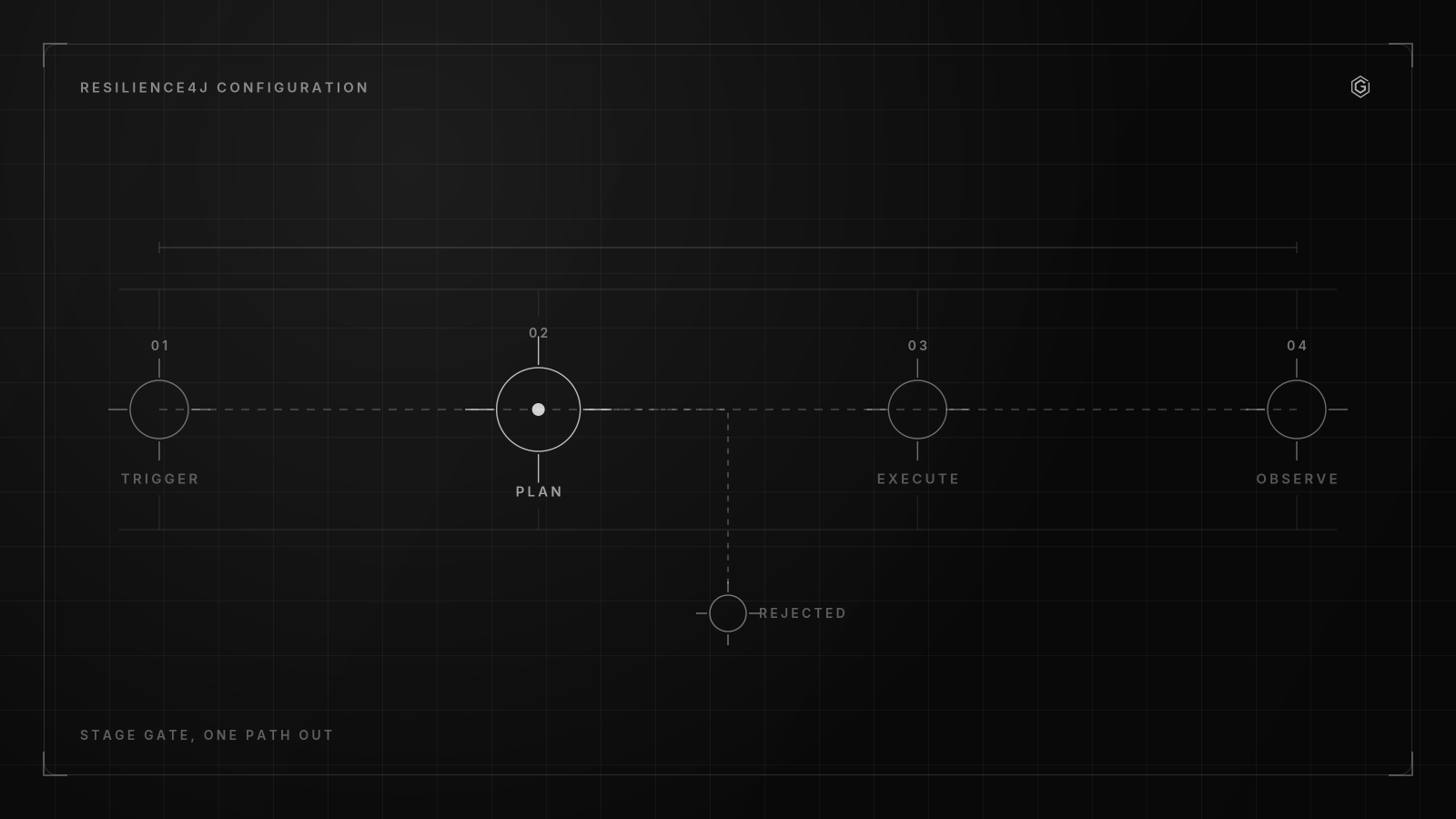
Application-level circuit breakers like Resilience4j operate in your process, with access to business exceptions and call semantics. Service mesh breakers like Istio operate in the proxy, with access to TCP and HTTP status but not your application's exception hierarchy. Running both creates redundant timeouts and conflicting state machines.
And the cost of running both layers is concrete. You configure a 5s timeout in Resilience4j and a 2s timeout in Istio's destination rule. The mesh kills the call at 2s, and your application logs a SocketTimeoutException.
Your breaker counts it as a failure. The circuit opens even though the upstream service is healthy; the mesh is the one timing out.
Deferring breaking to the mesh simplifies the application, and it also forces you to give up business-aware exception handling. A 404 from the downstream is not a failure. The mesh cannot tell. It counts every non-2xx as a failure unless you write per-route rules that mirror the application logic.
The decision: if your failure semantics are uniform, the mesh can handle breaking. If you have heterogeneous endpoints with mixed business exceptions, the application layer needs to own the breaker.
Designing Resilient Backend Systems with Circuit Breakers at both layers is defensible only when the layers operate at different timescales. The mesh handles network and connection-level failures, and the application handles semantic and business-level failures. Anything else is duplicated work.
Building something similar? Let's compare notes.
Response within 24 hours. No commitment required.
Uncommon Insight: Why Circuit Breakers Can Actually Worsen Thundering Herds
Circuit breakers can worsen the thundering herds they are meant to prevent when wait durations are synchronized across instances. The Half-Open state's limited probe count, combined with identical timers, produces a coordinated burst the moment the downstream recovers. The pattern that protects you becomes the pattern that kills you.
In the Half-Open state, a limited number of requests are allowed to pass through. If successful, it switches to Closed; if any fail, it reverts to Open and restarts the time-out timer. The Half-Open state helps prevent a recovering service from suddenly being flooded with requests, which could cause it to time out or fail again.
That is the theory. The practice is where most implementations break.
The default wait duration in OPEN is the same across every instance. When the downstream recovers, every instance's timer expires at the same instant, and every instance enters HALF_OPEN at the same instant. Every instance sends its permittedNumberOfCallsInHalfOpenState at the same instant.
The recovering downstream, which was barely holding, gets hit with a synchronized burst.
Designing Resilient Backend Systems with Circuit Breakers without jittered wait durations reproduces the thundering herd you installed the breaker to prevent.
The fix is to add randomized wait durations. Instead of waitDurationInOpenState: 30s, use a range: 25s to 35s per instance, and the downstream sees a gradual ramp, not a wall of traffic.
The second failure mode is the half-open sample size. Set permittedNumberOfCallsInHalfOpenState to 1 and a single transient failure re-opens the circuit for another full wait window. Set it to 10 and your recovering service absorbs 10 simultaneous probes, and the right value depends on your downstream's capacity to absorb probes, not on a library default.
Synchronizing Circuit Breaker State Across Distributed Instances
Resilience4j CircuitBreaker is implemented via a finite state machine with three normal states (CLOSED, OPEN, HALF_OPEN) and three special states (METRICS_ONLY, DISABLED, FORCED_OPEN). Each instance of your service runs its own breaker, and they do not share state. This is by design.
Sharing state across instances requires an external store: Redis, a database, a control plane, and the latency of that lookup runs on every call. The availability of that store becomes the availability of your breaker. The cure is worse than the disease.
In METRICS_ONLY state, Resilience4j CircuitBreaker generates all events and records metrics, but the circuit does not open when thresholds are breached. You use this when an external observer (a control plane, an SRE tool) is making the open or closed decision based on aggregated metrics from all instances.
The DISABLED state turns the breaker off entirely. Calls pass through. Metrics may or may not be recorded depending on configuration. You use this during known incidents where you want to bypass the breaker while you remediate.
FORCED_OPEN is the inverse: the breaker rejects every call without attempting them. You use this when an upstream team has confirmed an outage and you want to shed load immediately rather than wait for your own thresholds to trip.
Designing Resilient Backend Systems with Circuit Breakers across multiple instances means choosing between per-instance breakers with no shared state, or external coordination via METRICS_ONLY plus a control plane. The first is simpler and slightly slower to react. The second is faster and introduces a new dependency.
Validating State Transitions in CI/CD Pipelines
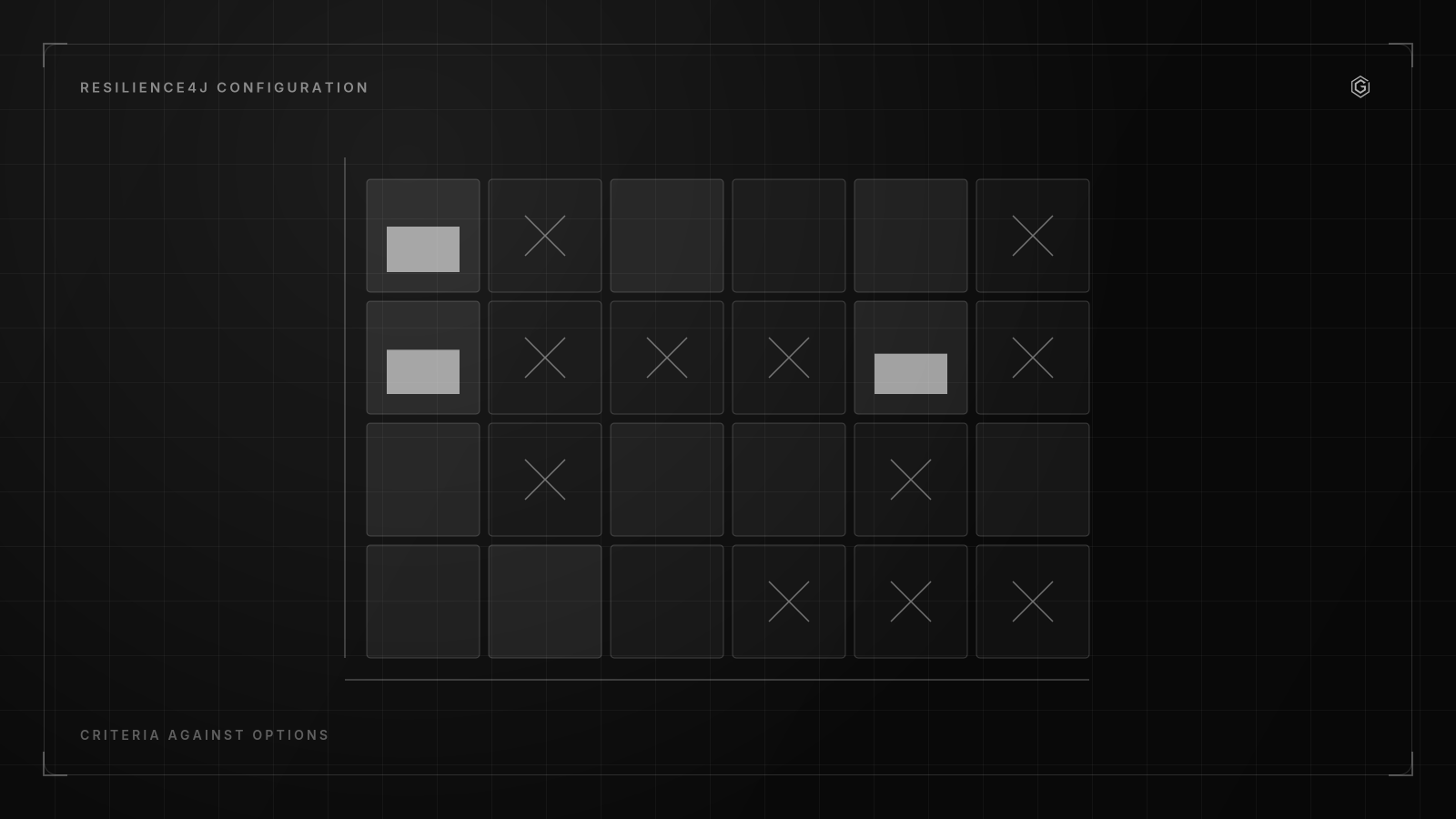
Circuit Breaker has three primary states: Closed, Open, and Half-Open. In the Closed state, if the number of recent failures exceeds a specified threshold within a given time period, the proxy is placed into the Open state and starts a time-out timer. Testing this transition under CI is where most teams give up and call it untested in production.
The hard part is not the assertion. It is the time advancement. Resilience4j's waitDurationInOpenState is real time.
Your test either sleeps for the full duration, or you inject a fake Clock. The first makes your CI suite slow. The second requires you to wire a Clock bean through your configuration, which most teams do not do until they need it.
The second testing challenge is the HALF_OPEN sample. You must verify that exactly N calls pass through, that a successful sample transitions to CLOSED, and that any failure transitions back to OPEN with the timer restarted. Mocking this with Mockito creates tests that pass but prove nothing about production behavior.
A better approach: integration tests against a real WireMock that returns 500 on demand, with a test-scoped Clock that you advance manually.
CircuitBreaker circuitBreaker = CircuitBreaker.of("test", CircuitBreakerConfig.custom()
.minimumNumberOfCalls(2)
.failureRateThreshold(50)
.waitDurationInOpenState(Duration.ofSeconds(5))
.permittedNumberOfCallsInHalfOpenState(1)
.build());


circuitBreaker.executeSupplier(() -> { throw new RuntimeException("boom"); });
circuitBreaker.executeSupplier(() -> { throw new RuntimeException("boom"); });


assertThat(circuitBreaker.getState()).isEqualTo(CircuitBreaker.State.OPEN);
On a recent build I took integration tests with a manually-advanced Clock over the obvious option of just sleeping, and the CI suite dropped its flake rate dramatically. Tests that depended on wall clock were the worst offenders.
Designing Resilient Backend Systems with Circuit Breakers means shipping tests for the state machine, not just for the happy path.
Ready to build something that lasts?
Response within 24 hours. No commitment required.
Frequently Asked Questions